A roof tarp is the right call when water is coming in and the permanent repair can't happen yet. It buys time, and only if it's put on safely.
That's the short answer. The longer one matters, because in Florida a tarp goes up fast after a storm and then has a way of staying up long after it should have come down. Below is when a tarp makes sense and when it doesn't. We'll also cover whether you should climb up there yourself, what a good install looks like, and how long you can lean on one.
This comes from the team at Superior Roofing & Restoration. We're veteran-operated, we've been at this for 34 years, and our Florida offices are in Tampa, Daytona, Jacksonville, Miramar Beach and Milton. We apply tarps on emergency calls all the time, so most of what follows is what we see in the field.
What a tarp is for
A tarp has one job. It keeps rain off the roof deck and out of the attic until someone can fix the actual problem.
The U.S. Army Corps of Engineers runs Operation Blue Roof after some major disasters, and USACE describes it as a way to cover damaged roofs with fiber-reinforced sheeting until permanent repairs can be made. That last part is the important bit. Even the federal program built around tarps treats them as temporary.
Fun fact: that program is why so many Floridians call a tarped house a "blue roof," whatever color the tarp actually is!
Superior Roofing & Restoration looks at every tarp the same way. It's a bridge to the real repair, never the repair itself.
When a tarp is the right call
Here's when we'd tell you a tarp makes sense:
- Water is actively coming in and the permanent fix is days away, not hours.
- Shingles are missing after a wind event and the bare underlayment or decking is showing.
- A limb punctured the roof and the limb has already been cleared off.
- The repair is waiting on something like materials or a permit. Florida requires permits for roofing work, and Superior Roofing & Restoration handles all permitting and inspections, but that paperwork still takes time.
In all of those cases, the goal is the same. Stop the water now, so your ceiling and insulation can start drying out.
When a tarp isn't enough
Some situations are past what a tarp can handle. If part of the roof is sagging, if a tree is still lying on the house, or if you can see the framing has shifted, a sheet of plastic on top won't make that safe. Get everyone out of that part of the house and call for help.
Water near electrical is the other big one. Ready.gov's hurricane guidance tells people not to touch electrical equipment if it's wet or if they're standing in water. If water is coming through a light fixture or running down a wall near an outlet, leave it alone. Shut off that circuit at the breaker only if you can stand somewhere dry while you do it.
Can I tarp my roof myself?
We get this question constantly, and we understand why. The storm passes, the drip keeps going, and a tarp from the hardware store feels like something you can handle.
Here's what the safety people say. OSHA's fall protection page calls falls among the most common causes of serious work-related injuries and deaths, and in construction it requires fall protection starting at six feet. Most single-story roof edges are already higher than that. NRCA, the national roofing contractors' association, advises homeowners to inspect their roofs only from ground level, because the risk of falling is too great without proper safety systems.
Add Florida conditions to that. A roof right after a storm is wet, often covered in leaves and debris, and the shingles may already be loose. That's exactly the surface you'd be standing on while wrestling a big sheet of plastic that turns into a sail in any breeze.
And if the storm is still around, don't go up at all. The National Weather Service's lightning safety message is simple: when thunder roars, go indoors. Florida afternoons can stack one storm right behind another, so a break in the rain doesn't always mean the lightning is done.
I'll say this plainly. Most homeowners shouldn't be on the roof, and we'd much rather get a call than hear about a fall. Our company line, 844-TARP-247, answers after hours for emergencies.
What you can do from the ground
You're not helpless while you wait, and there's plenty to do from inside:
- Catch the water. Buckets or bins with a towel in the bottom so it doesn't splash.
- Move what you can out of the room, starting with wood furniture and anything with a cord.
- Keep people out from under a bulging ceiling. A soft or sagging spot is usually holding water.
- Take photos of the ceiling and anything wet. They help whoever comes out to trace the leak.
What a proper tarp install looks like
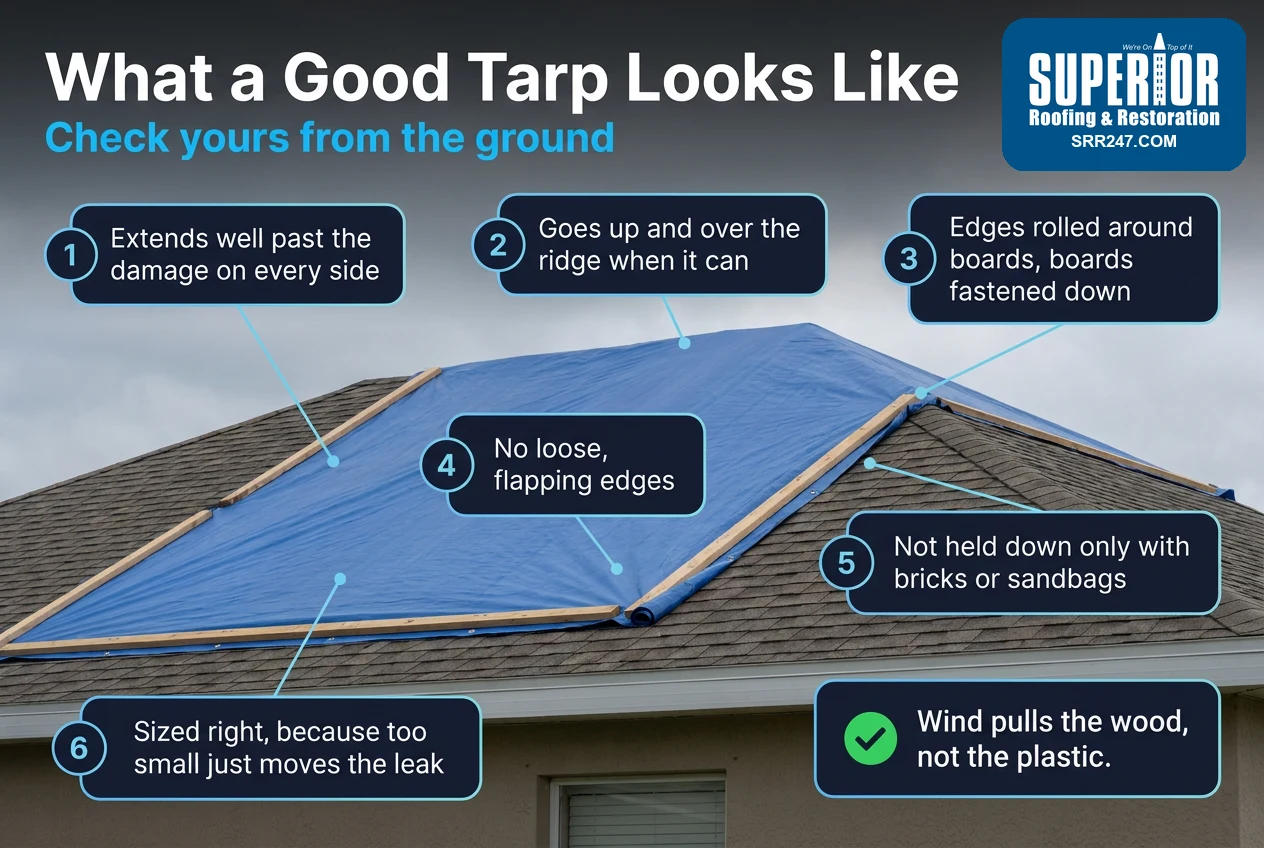
A tarp that's slapped on wrong can make things worse. It can trap water, add new holes, or peel off in the first gust and leave you right back where you started. Here's what a good install looks like, so you can tell whether the one on your house is doing its job:
- It covers more than the damage. The tarp should extend well past the damaged area on every side, because water travels under shingles before it shows up inside.
- It goes up and over the ridge when it can. That way rain runs over the top edge of the tarp instead of slipping underneath it.
- The edges are held down with boards. The tarp edge gets rolled around a strip of lumber and the board is fastened down, so wind pulls against the wood instead of tearing the plastic at each fastener.
- There are no loose, flapping edges. A flapping tarp wears itself out fast and can lift the shingles around it.
- It isn't held down only with bricks or sandbags. Weights shift, and in a strong wind they can come off the roof entirely.
- It's sized for the job. A tarp that's too small just moves the leak a few feet over.
If that feels like a lot, don't worry about memorizing it. Our reps can walk you through what's on your roof and why, and keep it simple.
Why we trace the leak before the tarp goes on
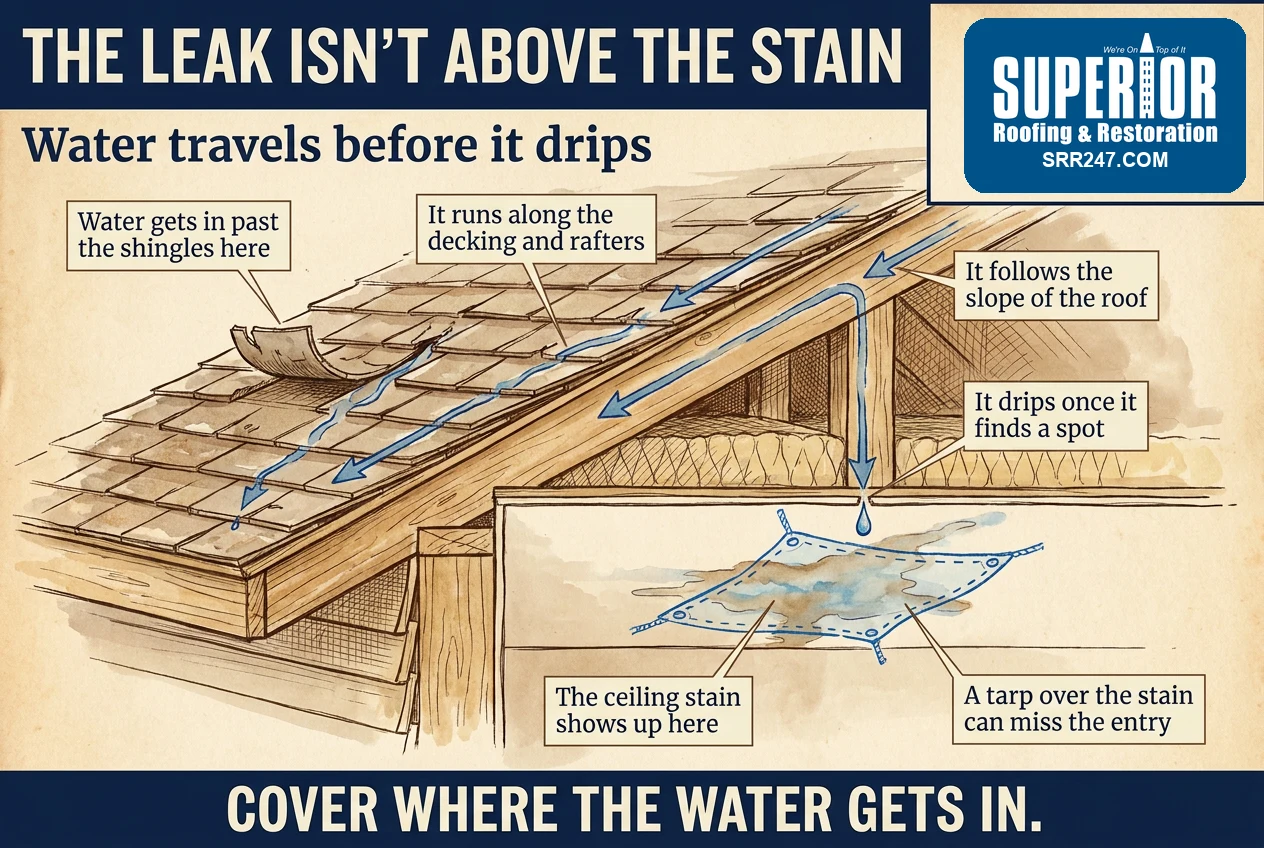
This is the part people don't expect. The stain on your ceiling usually isn't right under the hole in your roof. Water that gets past the shingles runs along the decking and rafters, following the slope, until it finds a spot to drip from.
So a tarp placed directly over the ceiling stain can miss the real entry point completely. That's why Superior Roofing & Restoration traces leaks from the attic on emergency calls. When we apply a tarp, we want it covering where the water is actually getting in, not where it happened to land.
How long can a tarp stay on?
There's no official expiration date we can point you to, so here's our field experience instead. Florida is hard on tarps. The sun and heat break down the plastic, the edges loosen a little with every gust, and a cheap, thin tarp can start to look rough surprisingly fast. This is closer to what we see in the field: a tarp should be measured in weeks, not seasons.
It isn't only about the tarp wearing out, either. Here's why waiting is a problem even when the tarp looks fine:
- Damage keeps going underneath. If water already got into the decking, it can keep softening that wood while it sits covered. Florida requires sound wood to pass inspection, so rot that spreads becomes part of the repair.
- The inside needs to dry. Your attic and ceiling have to dry out completely between rains. If they stay damp, mold becomes a real risk, and that adds a whole new set of costs.
- Fasteners are holes. Every fastener used to hold the tarp is a spot that has to be dealt with during the permanent repair.
While the tarp is on, look at it from the ground after every storm. If an edge has lifted, a board has shifted, or you see new drips inside, call us. Don't climb up to fix it.
After the tarp: getting the real fix
Once the water's stopped, the question becomes repair or replacement. A lot of homeowners brace for the worst here, and often that fear is wrong. Plenty of leaks come down to one flashing detail or one cracked pipe boot. If it's just a repair, we'll tell you that.
If the roof really is at the end of its life, it's still better to know. You can plan around a real answer, and we work with several financing partners if you need them. Coverage depends on your policy, so read it or call your agent. We don't interpret policies.
Water coming in right now? Start with our emergency roof repair page. Dylan covers Tampa. Charlie covers Daytona and Jacksonville. Pedro and Damon cover Miramar Beach and Milton on the Emerald Coast, where you can also call our Panhandle line at 850-987-0656.
Book a roof inspection
Once the tarp is doing its job, let us help you figure out what comes next. Our visit takes about 90 minutes. We trace the leak, take photos, bring a sample board, measure, and leave you with a firm written number. Superior Roofing & Restoration is a licensed Florida roofing contractor, CCC1325604.
Contact us to set it up, or call 844-TARP-247 any time for an emergency tarp.