A roof inspection is a close look at the roof covering, flashing, vents and gutters, plus signs of leaks inside. Here's what a Florida visit looks like.
You probably have better things to do with a weekday afternoon than meet roofers. A lot of homeowners fill out one form online and then get calls from four companies, each wanting its own visit. So it helps to know what a real inspection covers and how to tell whether the person on your roof is being straight with you. Then one visit can be enough.
This comes from the team at Superior Roofing & Restoration, a licensed Florida roofing contractor (CCC1325604) with offices in Tampa, Daytona, Jacksonville, Miramar and Milton. It's general information, not a substitute for someone looking at your actual roof.
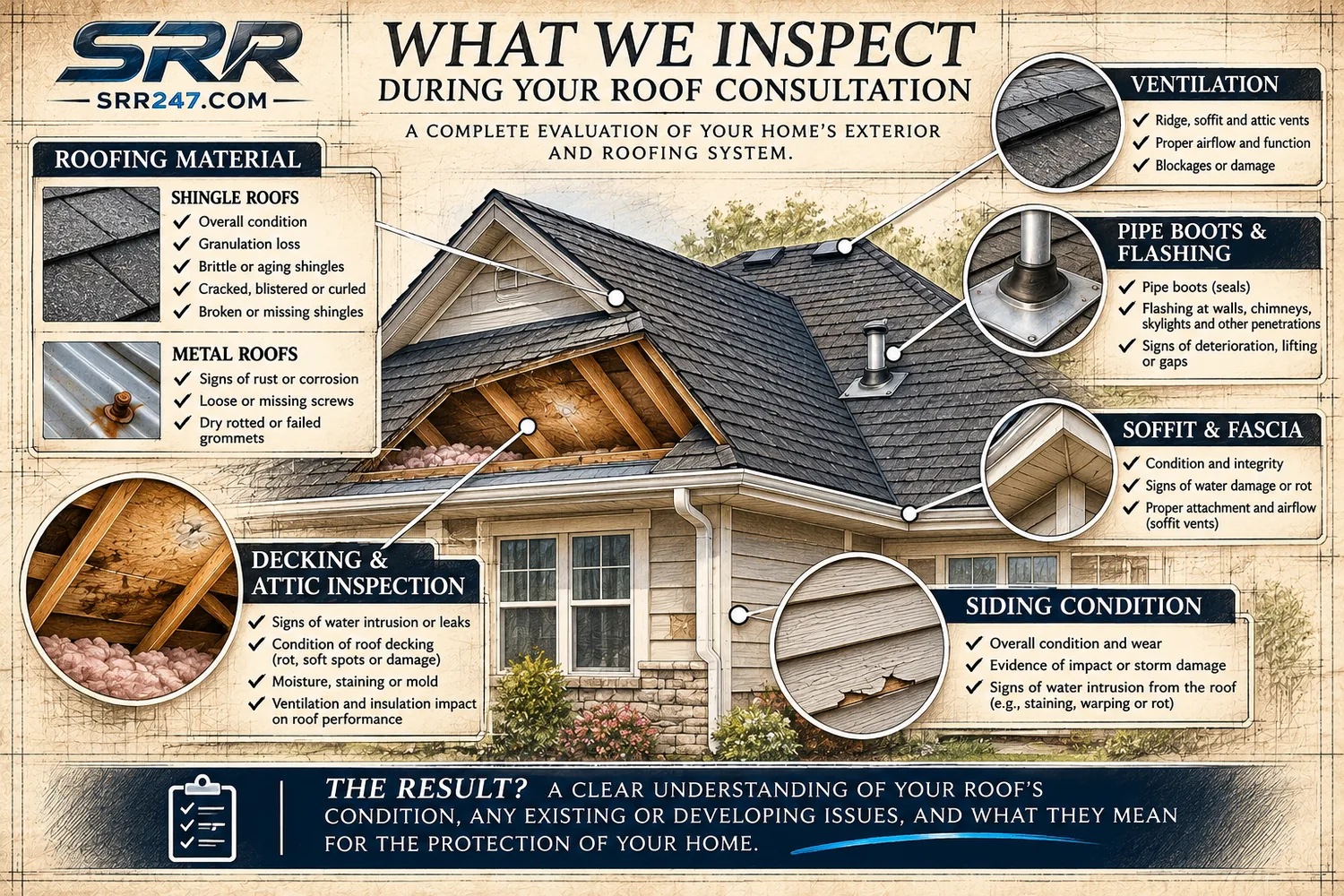
What a roof inspection includes
Home inspectors and roofing contractors may examine many of the same roofing components, but they're looking at them from different perspectives.
A home inspector evaluates the roof as part of the home's overall condition, identifying visible defects, potential concerns, and issues that may warrant further evaluation. InterNACHI's Standards of Practice provide a baseline for this process, including examining roof coverings, gutters, flashing, vents, penetrations, and accessible attic spaces.
A professional roofing contractor takes that evaluation several steps further.
We're not simply looking at what kind of roof you have or how old it might be. We're evaluating how well it's doing its job, and how much longer it can continue protecting your home.
That means looking beyond the shingles. A thorough roofing inspection includes examining the condition of the roofing materials, installation methods, ventilation, flashing, drainage, and, whenever accessible, the attic.
In fact, some of the most important information about a roof's condition isn't visible from the outside at all. The attic can reveal moisture intrusion, deteriorating decking, inadequate ventilation, and other problems that may go unnoticed from the roof's surface.
We're looking for more than existing damage. We're identifying developing problems, understanding why they're happening, and determining what they could mean for the home if left unaddressed.
The goal isn't to find a reason to replace your roof. It's to understand the condition of the entire roofing system so you can make informed decisions about protecting your home.
Sometimes that means a simple repair. Sometimes it means correcting a ventilation issue. And sometimes, when the roofing system can no longer provide reliable protection, replacement is the responsible recommendation.
On the roof
On a shingle roof, a roofing industry guide from NRCA's Professional Roofing magazine points to curling or splitting shingles as evidence of deterioration, and to dislodged or missing tabs as something to repair so the roof stays weathertight. It also says to note problems where other surfaces meet the roof, like sidewalls and chimneys, and to clear debris from valleys, gutters and drains.
Those joints are where a lot of leaks start. Flashing around a pipe boot or a skylight is a small piece of the roof that does a big job, and it's easy to miss from the driveway.
Inside the house
The other half of the job happens under the roof. Water stains on a ceiling or daylight showing through in the attic tell a roofer where to look harder outside. If you've noticed a stain, say so at the start of the visit. It saves time and points the inspection at the problem you actually called about.
Photos
Every problem a roofer reports should come with a photo. Most homeowners can't safely see their own roof, and NRCA says homeowners should only inspect a roof from ground level because the risk of falling is too great without proper safety systems. So the photos are your eyes up there. The same goes for your attic space. If someone tells you about damage and has no picture of it, ask for one.
4-point and wind mitigation inspections are different things
Florida homeowners hear about two other inspections that involve the roof. Neither one is the same as a roofing contractor's inspection.
4-point inspection
A 4-point inspection is an insurance inspection, not a roofing inspection. Chubb describes it as a review of four systems (roofing, electrical, plumbing and HVAC) that insurers often require on older Florida homes, and says it isn't as thorough as a full home inspection. Citizens Property Insurance publishes its own 4-point form and directs agents and Florida-licensed inspectors to use the current version.
Wind mitigation inspection
A wind mitigation inspection records a home's wind-resistant features on a state form, the Uniform Mitigation Verification Inspection Form. Section 627.711 of the Florida Statutes lists who insurers must accept a signed form from, including licensed home inspectors who've completed hurricane mitigation training, certified building code inspectors, certain licensed contractors, professional engineers and architects.
Wind mitigation inspections are not required but they do carry weight with your insurance company, often bringing premiums down. These are paid inspections through your county. We include wind mitigation inspections with all of our Florida roofs.
What our visit looks like
This is the part we can speak to directly. Charlie covers the Daytona and Jacksonville areas, Pedro and Damon cover the Miramar and Milton areas, and Dylan covers Tampa.
A consultation visit takes about 90 minutes. We take photos of what we find so you see what we see. We bring a sample board so you can look at actual materials instead of guessing from a brochure. We take measurements. And you get a firm written number before we leave.
If it's just a repair, we tell you that. A worn pipe boot or a few lifted shingles don't call for a new roof, and you should hear that plainly. See our roof repair page for that side of the work, or roof replacement if the roof is done.
The point of all that in one visit is so you're not left with a vague "we'll send something over" and a week of follow-up calls. Our team puts it this way: "We'll make getting a roof easier, clearer, and less stressful."
How long does a roof inspection take?
Ours runs about 90 minutes. Plan to be home for it, since the useful part is the conversation at the end, when you look at the photos together and go over the numbers.
How do I know this company is telling me the truth?
Fair question. Roofing has a reputation for a reason. We have a plain English verification document to send you if you want it. It comes with simple links to click to verify any contractor or company you have out against insurance records and state licensing boards. It also holds all of our licenses and insurance documents. Here's what to check, whoever comes out.
- Ask to see it. Every problem on the report should have a photo. A close-up of a cracked shingle is fine, but also ask for a wider shot showing where it is on your roof.
- Ask "repair or replace, and why?" A straight answer names the specific problem. "It's just old" isn't a reason on its own.
- Check the license. Florida's Department of Business and Professional Regulation has a public license search where you can look a contractor up by name or license number. Ours is CCC1325604.
- Be wary of anything offered for the inspection itself. Section 489.147 of the Florida Statutes bars a contractor from offering a homeowner a rebate, gift, cash or any other thing of value in exchange for letting them inspect the roof. If someone offers you a perk to get on your roof, that tells you something.
- Don't chase the lowest bid blindly. NRCA's advice to homeowners is to keep a healthy skepticism about the lowest bid, and if it sounds too good to be true, it probably is.
The same Florida statute also says a contractor can't interpret your insurance policy or advise you about your coverage unless they hold a public adjuster license. So if a roofer starts telling you what your policy will do, that's a red flag.
If the answer is a new roof
Sometimes the inspection says what you were afraid of. If it does, a few Florida rules shape what a reroof involves, and a good inspection will already account for them.
Under section 553.844 of the Florida Statutes, a roof replacement must include a secondary water barrier and the strengthening or correcting of roof-deck attachments and fasteners. For some houses in the wind-borne debris region, depending on insured value, it also has to include roof-to-wall connection work, capped at about 15 percent of the reroof cost.
The same section has what people call the 25 percent rule. If a roof was built, repaired or replaced under the 2007 Florida Building Code or later, and 25 percent or more of it is being repaired, replaced or recovered, only that portion has to meet the current code.
One honest limit here: nobody can see the roof deck in full until the old roofing comes off. Ask any roofer how they handle rotted sheathing found during tear-off, and get the answer in writing. With a thorough inspection, the amount of decking that needs to be replaced can be fairly accurately estimated. We include this in our quotes and, if we are off, we won't charge you on the back end. Our prices are firm.
How to get ready (it doesn't take much)
You don't need to prepare a lot, which is sort of the point.
- Clear a path to the attic hatch if you can. Closets are the usual spot.
- Take note of any ceiling stain and when it showed up, especially if it only appears after hard rain from one direction, and let your consultant know where they are.
- If you have the roof's age or last permit date, let us know. If you don't, that's fine. We can do a search if we need to.
- Put the dog in a safe location. Ladders and nervous dogs don't mix.
How often should a Florida roof be inspected?
NRCA recommends homeowners inspect their roof systems at least twice a year, preferably in spring and fall, plus after severe weather such as a hurricane or hailstorm. For a homeowner, that means a look from the ground with binoculars and a walk through the attic and upstairs ceilings. Leave the roof surface itself to someone with the right safety gear.
FAQ
What does a roof inspection include?
A check of the roof covering, flashing, vents and other penetrations, gutters and downspouts, and signs of leaks inside, with photos of anything wrong and a recommendation on whether the roof needs a repair or a replacement.
How long does a roof inspection take?
It varies with the size and shape of the roof. Our visits take about 90 minutes, which includes going over the photos and the written number with you.
Is a roof inspection the same as a 4-point inspection?
No. A 4-point inspection is an insurance inspection covering the roof, electrical, plumbing and HVAC, done by a licensed inspector. A roofing inspection is about the roof as the main form of protection for your home and what it needs.
Do I have to be home for the inspection?
Yes. We need to check your attic if you have one and your ceilings. You'll want to see the photos, know what they mean and ask questions while the person who took them is standing in front of you.
Sources
- InterNACHI, International Standards of Practice for Performing a General Home Inspection: roof items a home inspector checks, what the inspector isn't required to do, not a prediction of future conditions
- Professional Roofing (NRCA), "Tech Today," October 2013: twice-yearly inspections in spring and fall, after severe weather, shingle curling and splitting, missing tabs, sidewalls and chimneys, debris in valleys and gutters
- NRCA, "NRCA Urges Homeowners and Business Owners Affected by Severe Weather to Use Caution When Repairing Their Roof Systems," July 2022: ground-level inspection only for homeowners, skepticism about the lowest bid
- Chubb, "Why a 4-point inspection is essential for Florida homeowners": the four systems, licensed inspector, not a full home inspection, older homes
- Citizens Property Insurance, Roof and 4-Point Inspection Form Updates, March 20, 2025: current 4-point and roof inspection forms for agents and Florida-licensed inspectors
- Florida Statutes 627.711: uniform mitigation verification inspection form and who may sign it
- Florida Statutes 489.147: prohibited property insurance practices for contractors, including offering anything of value for a roof inspection and interpreting policies
- Florida Statutes 553.844: reroof requirements for secondary water barriers, roof-deck attachment and roof-to-wall connections, and the 25 percent rule
- Florida DBPR license search: verify a contractor's licence