Architectural shingles are thicker, layered asphalt shingles that outlast 3-tab. The install details on your estimate matter as much as the shingle itself.
That's the short version. The longer one matters because "architectural" is a word you'll probably see on any roofing quote you get, and on its own it tells you less than you'd think. Two estimates can both say architectural shingles and describe very different roofs.
You don't need to become a roofing expert to sort this out. You need to know what the impact and wind ratings are and how those ratings fit how you want your roof to perform. Our reps walk you through the details while keeping it simple.
What makes a shingle "architectural"
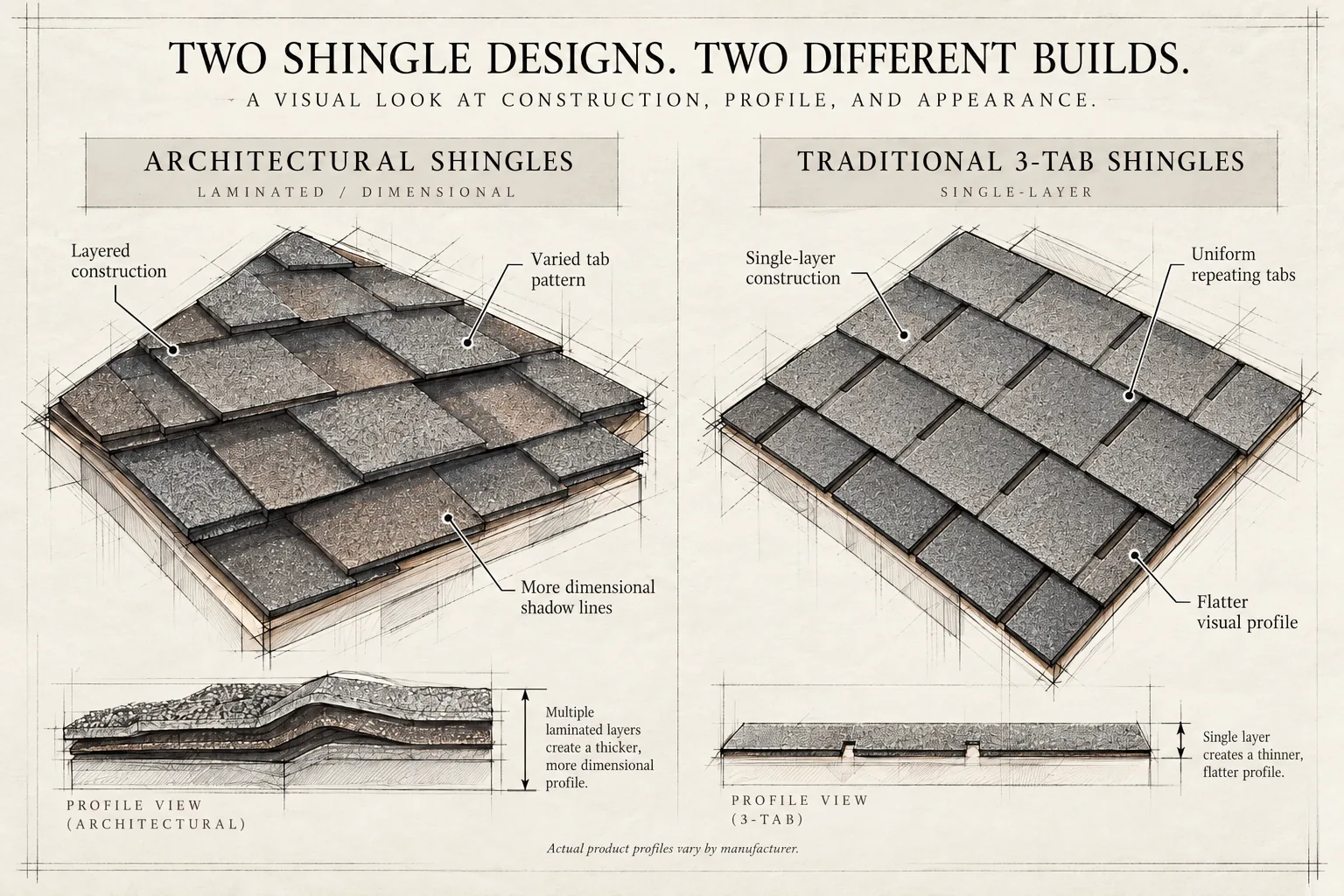
The Asphalt Roofing Manufacturers Association (ARMA) sorts steep-slope asphalt shingles into a few types. Strip shingles are the flat ones, about three times as long as they are wide, and the most common strip shingle is the 3-tab. Laminated shingles have more than one layer of tabs to build extra thickness. ARMA says those are also called three-dimensional or architectural shingles.
So architectural and laminated mean the same basic product. CertainTeed describes its Landmark line as a "dual-layered design," and IKO calls its architectural lines a laminated shingle.
ARMA says that thickness gives the roof visual depth, which is the shadowed, uneven look most people picture. It also adds curb appeal and durability.
How long do architectural shingles last? - Breaking down the inconsistency
The International Association of Certified Home Inspectors puts architectural asphalt shingles at 30 years and 3-tab at 20 in its life expectancy chart. You will repeatedly hear 20 years for a 3-tab and 30 years for an architectural shingle but those are estimates - not expiration dates. These numbers are based on manufacturer warranties. However, the warranties are almost always depreciating warranties and a 30 year shingle with a 30 year warranty will likely only be covered for 20 years. The manufacturers base their life expectancy on how long a roof will last in perfect conditions. Rarely do we see a home in these conditions, but it does happen!
Additionally, and possibly more importantly, insurance companies - especially in Florida - will start demanding a roof replacement between 10 and 20 years, depending on what materials are on your roof.
The take home: Architectural shingles last the longest in the asphalt shingle world. There are many different formulations and engineering quirks. We will help you sort all that out based on how you want your roof to perform.
Are architectural shingles worth it over 3-tab?
For most homeowners replacing a roof, yes. The longer expected life alone makes the case. The better question is which architectural shingle, installed how.
Here's where people get tripped up. Architectural doesn't automatically mean wind-rated to the top class, and it doesn't mean hail resistant. Those are separate test ratings, and they're printed on the product's spec sheet, not in the name. Our representatives know the specs inside and out. We will take the headache out of the process for you and let you know what you need to for your particular roofing solution.
Additionally, Superior Roofing & Restoration does not install 3-tab shingles. We have been at this for 34 years and have seen it all. We use materials and installation techniques that have been proven to be superior. We guarantee our work. And we cannot confidently guarantee a 3-tab shingle. So, we don't install them.
Wind ratings, decoded
There is a lot of very technical education here! It can be a lot, but don't let it overwhelm you. Our representatives can easily explain this to you so you don't have to become an expert!
Here is the technicality: You'll see two wind test standards on asphalt shingle spec sheets. ARMA's product and test standards page explains both.
ASTM D3161 (fan-induced method). A deck of shingles is prepared and conditioned, then fan-driven "wind" is blown across it. The highest wind speed reached without any part of a shingle lifting sets the class. Class F is the top rating. ARMA points out a mismatch worth knowing: building codes base wind design on three-second gusts, but this test runs for two hours.
ASTM D7158 (uplift resistance method). This one looks at the strength of the sealant bond plus the shingle's own stiffness. ARMA says the lab results can be compared directly to the three-second gust design wind speeds in the code. Class H is the top rating here.
The re-roof guide published for the City of East Point, a metro Atlanta city working from the 2018 International Residential Code, says asphalt shingles have to be tested to ASTM D7158 and meet the code's classification table. Check what your own city or county requires.
Some architectural shingles carry both top classes. IKO's Dynasty spec sheet lists D3161 Class F and D7158 Class H. Whatever the brand, ask to see the ratings on paper for the exact product in your estimate.
Wind warranties come with conditions
Some manufacturers attach a separate wind warranty, and the fine print matters. CertainTeed's Landmark page lists a 110 mph wind-resistance warranty with an upgrade to 160 mph available, and says the upgrade requires CertainTeed starter and CertainTeed hip and ridge. In other words, the accessories on your estimate can decide which wind coverage you actually get. This is one of the primary reasons IKO and Tamko are our preferred manufacturers. The fine print doesn't automatically disqualify you from warranty claims from day 1 with these companies.
To set your mind at ease, we offer Company Guarantees on your roof. The warranty process is notoriously difficult to navigate and loaded with caveats. With our guarantees, you don't have to worry about the tangled mess of navigating warranty claims.
Impact ratings and hail
Hail is a real concern in north Georgia. The National Weather Service office in Peachtree City found in its severe weather climatology that nearly all hailstorms in its area hit between February and August, and April leads.
The rating you'll see for hail is UL 2218. ARMA describes it as a lab test that drops steel balls of different sizes from 12 to 20 feet onto a deck of shingles, with four classes and Class 4 as the best. ARMA also notes impact resistance isn't required by the building codes. So it's an option you choose.
Malarkey Roofing Products lays out the Class 4 test in plain terms: a 2-inch steel ball dropped from 20 feet, twice in roughly the same spot, and the shingle passes if the back shows no tearing, cracking, splitting or other opening. Malarkey also quotes UL saying the test doesn't evaluate weathering, temperature, aging or similar effects.
Two things to hear straight:
- Architectural isn't the same as Class 4. CertainTeed Landmark and IKO Dynasty, both architectural, are listed as UL 2218 Class 3 on their own product pages.
- An impact rating isn't hail coverage. IKO's impact rating disclaimer on the Dynasty page says the rating isn't a guarantee of impact resistance against hail, and that hail damage isn't covered under its limited warranty. You'll want to check your homeowner's insurance policy to make sure you are covered for that.
Algae-resistant shingles
Dark streaks on a shingle roof are usually algae. ARMA's algae discoloration page says algae-resistant shingles are built to inhibit growth for extended periods, and suggests considering them when you reroof. It also warns against power washing or brushing a shingle roof.
On the two product pages we checked, algae coverage runs on its own clock. Algae loves organic material and thrives in shaded areas that don't fully dry out. To put that into context, your shingles are made of oil based asphalt - an organic material - and the tree coverage around your house keeps your roof in the shade and unable to fully dry out.
Algae resistant shingles are infused with copper and sometimes zinc while the amount of oil based materials is lower. In short, there is less organic material and more inorganic material. Algae does not have perfect conditions to grow and shorten the life of your roof.
However, your roof may not need the added protection and cost of algae resistance. We recommend this upgrade when there is a significant amount of tree coverage or shade on the roof.
What the manufacturer warranty actually covers
"Lifetime" has a defined meaning. On the Dynasty page, IKO defines it as the period from the end of installation for as long as the owner owns the building. That's ownership language, and it says nothing about how long the shingles will last.
Both of those product lines also come with an early-coverage period. IKO's warranty page describes its Iron Clad Protection Period as 15 years of coverage for manufacturer defects on its Performance products. CertainTeed lists 10-year SureStart protection on Landmark.
Then there are extended tiers that only certain installers can offer. IKO says Select and Craftsman Premier members of its ROOFPRO program can offer extended Iron Clad Protection, and that the ROOFPRO contractor registers the extended warranty for you. The Dynasty page adds that those extended warranties may have different application requirements.
And if you sell the house? IKO says transfer terms vary by year and product, so check the limited warranty that was in effect when your shingles went on.
Questions worth asking any roofer, in writing:
- Which manufacturer warranty comes with this roof, standard or an extended tier?
- If it's extended, who registers it, and when do I get the paperwork?
- Does it require that manufacturer's starter and ridge cap?
- What would void it?
- What covers the workmanship, separate from the shingles, and for how long?
The NRCA contractor checklist, published on the FORTIFIED Home site, puts it simply: read and understand any roofing warranty offered, and watch for provisions that would void it.
Again, Superior Roofing & Restoration is aware of the headache that comes with sorting out manufacturer warranties. We also offer Company Guarantees so you don't have to mess with the manufacturer's legalese.
How to compare two estimates line by line
To start, I'll say this: Let us help you. We will gladly walk you through, line by line, and explain the difference and the benefits of each estimate.
A roof is a system of parts. ARMA's roofing system components page lists six parts that work together: shingles, underlayment, ice and water barriers, starter strip, hip and ridge, and balanced attic ventilation. When two quotes look far apart, look at those other five first, then at what happens to the wood underneath.
Put both estimates side by side and look for each of these.
Tear-off or overlay. Is the old roof coming off down to the deck? East Point's re-roof guide says no more than two layers are allowed, and a new roof can't go over one that's water-soaked or already has two or more layers. Even where an overlay is legal, you can't see the deck you're covering. Superior Roofing & Restoration does not do overlay roofing. These roofing solutions cause more problems than they fix.
Decking replacement policy. On a tear-off, nobody knows the deck's condition for sure until the shingles are off. We do check the attic for signs that the decking needs replaced but there are almost always surprises when the shingles come off. The East Point guide says boards or sheathing that are "warped, cracked or delaminated between supports" have to be repaired or replaced. Florida also demands wood in good structural condition to pass inspection.
Underlayment. ARMA calls it a secondary water barrier between the deck and the shingles. Ask what product, and whether it's synthetic or felt. Superior Roofing & Restoration uses Ice & Water Shield across the whole roof deck in Florida. There are a lot of companies out there that will play with the wording on their estimates to imply they are using higher quality underlayment while they cut corners. We can help you identify these phrases and avoid misconceptions and surprises.
Starter strip. ARMA says starter products give the first row of sealant that helps prevent blow-offs. East Point's guide requires a starter course at the eave. Superior Roofing & Restoration always uses Starter Strip. We guarantee our work so we do it right the first time.
Drip edge. Drip edge is required around the entire perimeter. If one estimate lists it and the other doesn't, you should ask why.
Hip and ridge. Matching ridge cap is part of some wind warranties, as the CertainTeed example above shows. Superior Roofing & Restoration uses matching Hip & Ridge on every roof we build. The only deviation - homeowners occasionally request a different color Hip & Ridge shingle for aesthetic reasons. That never changes the scope of work or the quality of materials - just the color.
Ventilation. ARMA's position is that steep-slope attics should be vented, with balanced intake and exhaust. The East Point guide restates the code's ventilation area rules and says insulation can't block eave vents. ARMA ties balanced ventilation to keeping the attic closer to outside temperature, which it says helps prevent premature shingle deterioration. We will optimize your ventilation with the highest quality solution for your unique roof. This is most often a high-flow ridge ventilation system.
Flashing, vents and pipe boots. East Point says roof jacks and vents in poor condition, or badly rusted, must be replaced, along with damaged or rusted metal. Superior Roofing & Restoration replaces them all! To guarantee you won't have leaks, this is a must.
Permit and inspection. Re-roof needs a permit and a final roof inspection in the state of Florida and in some counties and cities in Georgia. We handle all permitting and inspections for your roof so you don't have to navigate that process on your own. Let our experience make it simple!
Cleanup. Not every company is transparent about their dump fees or clean up. Make sure this is part of your estimate and contract. Superior Roofing & Restoration includes all of this in our price and we are very strict about cleanup practices with nail sweeps throughout your project and on the final walkthrough.
Book a roof inspection in metro Atlanta
Superior Roofing & Restoration is a veteran-operated company with an office in Peachtree Corners, and Victoria covers Atlanta for our team. An inspection visit takes about 90 minutes. We walk the roof, take photos of what we find, show you a sample board, take measurements, and hand you a firm written number. If the roof just needs a repair, we'll say so.
If you're already holding two quotes, run both through the checklist above before you sign anything. Book a roof inspection, read about our roof replacement work, or contact us. You can also call 844-TARP-247.
Sources
- ARMA, Types of Asphalt Roofing: strip and 3-tab shingles; laminated shingles also called architectural
- ARMA, Asphalt Shingle Product and Test Standards: ASTM D3161 Class F, ASTM D7158 Class H, three-second gust vs two-hour test, UL 2218 drop test and classes, impact resistance not required by code
- ARMA, Asphalt Roofing Systems Components: the six roof system components and ARMA's ventilation position
- ARMA, Algae Discoloration: algae-resistant shingles and cleaning cautions
- InterNACHI, Standard Estimated Life Expectancy Chart for Homes: architectural 30 years, 3-tab 20 years; severe weather, hurricanes included, can shorten roof life
- City of East Point GA (SAFEbuilt), 2018 IRC Residential Re-Roof guide: permit and final inspection, two-layer limit, recover limits, sheathing repair, starter course, drip edge, ventilation rules, ASTM D7158
- Malarkey Roofing Products, Class 4 impact resistance shingles: Class 4 steel-ball test and UL's note on weathering and aging
- IKO, Dynasty performance shingles: laminated; D3161 Class F, D7158 Class H, UL 2218 Class 3; impact rating disclaimer; "lifetime" definition; algae warranty; ROOFPRO extended warranty note
- IKO, Warranty information for homeowners: Iron Clad Protection, ROOFPRO extended coverage and registration, transfer terms
- CertainTeed, Landmark shingles: dual-layered design, UL 2218 Class 3, SureStart, StreakFighter algae warranty, wind warranty upgrade requirements
- National Weather Service Peachtree City, severe weather climatology: hail season in north and central Georgia
- FORTIFIED Home (IBHS) with NRCA, How to Select a Roofing Contractor: written proposal, warranty reading, price as one criterion